


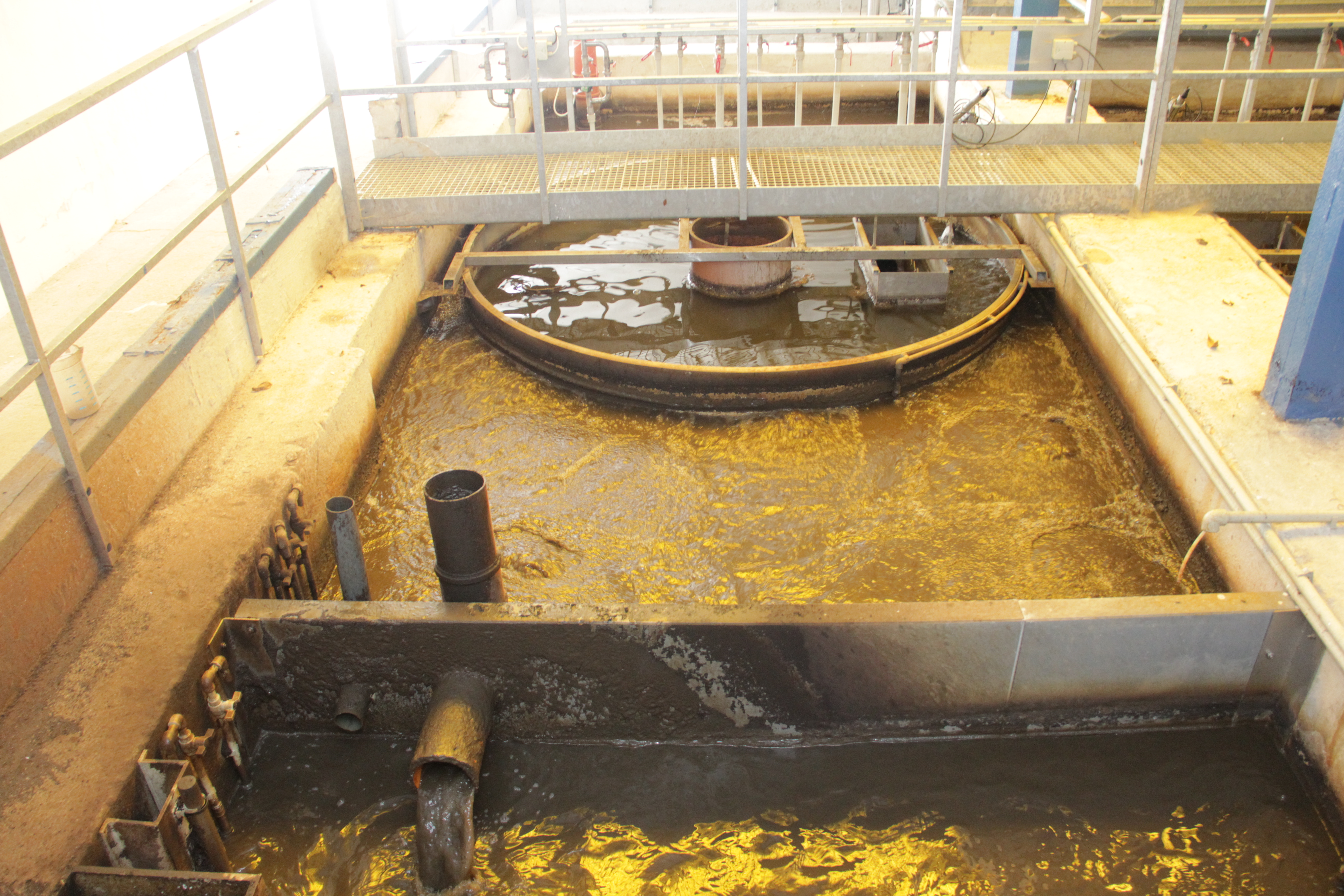
Below you will find a basic description of the activation treatment plant and its basic modifications. But maybe you are looking for something more specific, for example:
- Normal maintenance of the activation treatment plant - what and how often to do so that the treatment plant cleans for us
- How to set up activation cleaner
- Faults of the activation treatment plant - if the treatment plant is no longer working
- Start of operation of the activation treatment plant - you bought a new treatment plant and do not know how to operate it
Basic Description
The most common and also the most efficient type of treatment plant is the activation treatment plant. It works with activated sludge, which is a mixture of microorganisms that clump together into flakes. In essence, it is an intensive imitation of natural processes. In order for these processes to take place intensively, it is necessary to ensure sufficient air for the microorganisms, which is why these treatment plants are equipped with a blower and an aeration system. They are therefore characterized by the fact that air is blown into the water in them. Microorganisms use dissolved oxygen mainly to oxidize organic substances, which they convert into water and carbon dioxide. Under certain conditions, these treatment plants can also oxidize ammonia (a product of urea hydrolysis) into nitrates, which are much less harmful to the environment than ammonia, and again, with a certain arrangement, these treatment plants can also convert nitrates into nitrogen gas and thus completely remove nitrogen compounds from the water. To a limited extent, they can also remove phosphorus, which they accumulate in their cells, and it is then removed from the water with excess sludge. This process can be promoted by chemical precipitation.
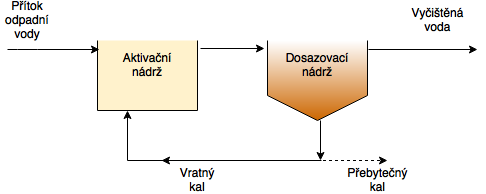
The actual principle is very simple: water flows into the activation tank, in which microorganisms (mostly bacteria) clustered in flakes are dispersed. This tank is aerated and this is also where most of the water purification takes place. When the waste materials are removed from the water, it is necessary to separate the clean water from the microorganisms. The activation mixture (a mixture of water and activated sludge, or microorganisms) is led into the settling tank, where the flakes of activated sludge settle to the bottom and the cleaned water, on the other hand, flows out of the upper part of the settling tank. Activated sludge is drawn from the bottom back into the activation tank. This ensures that the settling tank does not fill up and the sludge does not flow into the drain, that there is enough activated sludge in the activation tank, and that microorganisms do not stay unnecessarily long at the bottom of the settling tank, where there is significantly less oxygen than in the activation tank.
Several key conditions need to be ensured for the good functioning of the activation treatment plant:
- good aeration of the activation tank (ensures sufficient oxygen and good mixing - sludge sedimentation in the activation tank is undesirable!)
- sufficient activated sludge in the activation tank
- sufficiently intensive pumping of the return sludge from the settling tank back to the activation tank (this is the most common defect at the WWTP)
Variants of activation process
S settling/accumulation tank
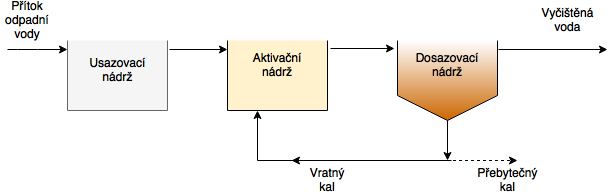
In addition to this very basic layout, there are a large number of other variations. At domestic wastewater treatment plants, an accumulation tank or a settling tank, or a tank that fulfills both these functions, is quite often placed in front of the activation tank.
The storage tank serves to equalize the inflow of wastewater. Water is usually pumped from it using a mammoth (pneumatic pump) into the activation tank. The amount pumped is then dependent on the amount of water in the storage tank. Equalization of the inflow increases the residence time in the activation tanks and reduces the load on the settling tank.
The sedimentation tank is already the first stage of wastewater treatment. There are mechanically separated settleable waste substances and the loading of the activation tank with organic substrate is reduced. The settling tank needs to be cleaned regularly, otherwise the settled sludge may rot, which is manifested by the sludge floating to the surface, the formation of biogas, odors, and the activated sludge may also be damaged by, for example, sulphide sulfur, which is formed in the rotting settling tank.
S separated denitrification and nitrification
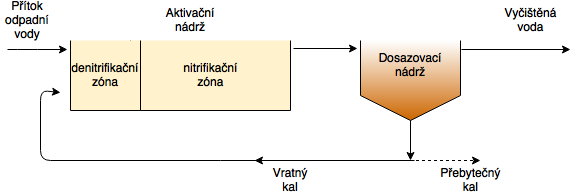
Another modification is the division of the activation tank into denitrifying and nitrifying zones. This division is important mainly because of the elimination of nitrogen pollution. The principle is that the nitrification tank is permanently aerated and the nitrifying bacteria here oxidize ammonia (ammonia) to nitrates. These are then returned together with the return sludge to the denitrification zone at the beginning of the activation. The presence of oxygen in the denitrification tank is not desirable, because instead of oxygen, the bacteria here use nitrates for the oxidation of organic substances and their growth (however, they prefer to use oxygen and in order to remove nitrates, oxygen must not be present). This part of the treatment plant should therefore not be aerated, but it is necessary to keep the sludge so-called "floating". At large treatment plants, for this purpose, for example, propeller mixers are used. At residential treatment plants, the mixer is a relatively luxurious element and more often a compromise is chosen, and the denitrification zone is mixed with a coarse-bubble (sometimes medium-bubble) aeration system (the nitrification zone is then fine-bubble, which achieves the best transfer of oxygen to the water). In such an arrangement, it is necessary to adjust the aeration of the denitrification zone so that the sludge is suspended and its sedimentation does not occur, and at the same time, that the amount of blown air is as small as possible.
Landing tank
Normally, the activation treatment plant is improved by modifications to the settling tank. Small modifications concern, for example, the outflow of cleaned water, which can be discharged via a saw-shaped edge from the surface, or through a shallowly submerged perforated pipe. These are more details. The removal of floating substances from the level of the settling tank is of great importance in order to reduce the demands on the operator. This is usually realized by means of a shallowly submerged funnel from which water is drawn off by means of a mammoth and the floating substances are sucked up with this water and returned to the activation tank. Sometimes the system is improved by a slight leveling of the surface, when an air supply is introduced shallowly below the level of the settling tank and small bubbling creates ripples on the surface that move the floating substances to the funnel. Here, however, watch out for too intensive aeration, which could disturb the sedimentation and swirl the contents of the tank. Then the sludge would not separate from the purified water and run into the drain.
Sometimes a screen is installed between the activation and settling tank (into the inlet of the settling tank). This prevents the entry of small objects that could clog the technology. Over time, however, it becomes overgrown with microorganisms, until it becomes completely overgrown, and the water then, according to the design of the treatment plant, overflows from the activation tank straight into the drain. If the treatment plant is equipped with a sieve, it needs to be cleaned regularly. In case of bigger problems, it is possible to remove it, without a negative impact on the function.
Membrane treatment plant
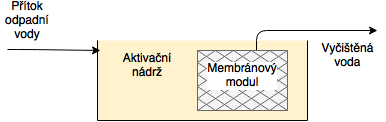
An absolutely essential modification is the replacement of the settling tank with a membrane module. This is either inserted directly into the activation tank or into the so-called "membrane chamber". The membrane replaces the settling tank and separates the purified water from the activated sludge. It is assisted by pumps that suck purified water through the membrane. These treatment plants achieve absolutely top discharges. Purified water also contains very few bacteria (which do not pass through the membrane) and is therefore also suitable for irrigation. These treatment plants can also be smaller, because they do not depend on the sedimentation properties of the activated sludge, and thus there can be a greater concentration of this in the activation tank. On the other hand, membranes require more investment and require more care and occasional regeneration.
Precipitation of Phosphorus
The last common addition is the expansion of the treatment plant by precipitation of phosphorus. About 60% of phosphorus from wastewater is biologically captured in activated sludge bacteria. For higher efficiencies of 90-95%, it is necessary to resort to chemical precipitation. This consists in dosing aluminum or iron salts, which bind phosphorus into insoluble precipitates, which become part of the activated sludge. Phosphorus is then removed from the sludge during sludge removal.
Drainage of the treatment plant is an important activity. A person produces approximately 120 g of organic substances per day. The activation treatment plant oxidizes these substances into water and carbon dioxide. Microorganisms use this oxidation to generate energy for their life and growth. And the other half falls precisely on growth (in classic words). So, from 120 g of organic substances produced by humans, roughly 60 g of sludge produced by a wastewater treatment plant is created. Common sludge solids concentrations are 3-4 g/l. It follows from this that approximately 15 liters of sludge should be removed per connected person per day. In practice, it will be slightly less, because a certain small part of the sludge escapes to the drain, and the sludge can be thickened when the aeration is turned off. In particular, domestic treatment plants with old sludge exhibit the activity of higher organisms that eat bacteria and thereby reduce the amount of sludge. However, we mustn't forget about desilting. If you do not sludge the treatment plant, it does not mean that sludge is not produced or does not leave the treatment plant. An important test here is to pour 1 liter of activated sludge from the activation tank into a container with a scale and read the position of the sludge/water interface after 30 minutes. The optimal value is 300-500 ml/l. Below 200 ml there is very little sludge and above 800 ml the treatment plant is already hardened and needs to be de-sludged.
SBR
There is yet another variant of the activation treatment plant, where everything takes place in one tank and the individual phases are separated from each other not by space, but by time. It stands for SBR, which stands for Sequencing Batch Reactor. However, this is a modification so significant that we will talk about it elsewhere :-).
In conclusion
The activation treatment plant is a robust device that can transform wastewater into high-quality purified water in a short time. The effluent from the activation treatment plant is significantly better than from other technologies, for example from biofilm reactors, earth filters, various types of vegetation (for example, root) treatment plants. This should be the technology of first choice for most house cleaning installations. However, this technology is quite suitable for all cases.
Where the activation treatment plant is suitable:
- u family houses
- u apartments
- for industrial wastewater (it depends on the type of water)
- restaurants
Where, on the other hand, it is not suitable:
- for extremely rare wastewater
- for objects with irregular operation, typically for cottages occupied on weekends or only occasionally