


First of all, it is necessary to realize that there are many variants of activation treatment plants, and even if the principle is always practically the same, the specific design can be very different. Therefore, the following text will be rather general, and for understanding we recommend first studying, how the treatment plant actually works, it is nothing complicated.
How often to take care of the treatment plant
This is probably a key question, not only for the owner of the treatment plant, but also for future owners. The idea that the treatment plant works completely by itself and does not need to be supervised in any way is wrong. Although it is true that what the eyes cannot see, the heart does not ache, but when a person is doing something, he should do it properly. If you are a hobbyist, you can devote some time to the treatment plant every day, but it is not necessary. If the treatment plant has been functioning well for a long time and you already have a "feel" for its operation, an inspection even once a month is enough. However, from personal experience we can recommend checking the treatment plant once a week. Usually this check will take 5-10 minutes, once in a while, say several times a year, then it is advisable to spend more time, about 30-60 minutes.
Activities performed weekly
First of all, it is advisable to keep an operating diary, perhaps also in the form of a table or by writing it in a calendar. So once a week you fill in one or two numbers in the table.
Next is good:
- Open the treatment plant and visually check that:
- Air blows where it's supposed to blow and doesn't blow where it's not supposed to blow
- Kal is brown in color (black or gray are not correct colors)
- The treatment plant does not smell (the smell of a properly functioning treatment plant can be described as "earthy")
- Return sludge is pumped
- There is no thick layer of floating sludge (the so-called "blanket") on the settler or elsewhere
- If the inlet is pumped, that pumping works
- The number of boxes is minimal
- If you use chemicals for e.g. precipitation of phosphorus, there is a sufficient amount in their tank
- Pour the activation sludge (1 liter) into a plastic measuring cup and let it settle for 30 minutes. Then we can see that:
- Color and turbidity of the effluent (water above sludge) are acceptable (water can be slightly yellow to colorless, turbidity minimal to none)
- The sludge is the right amount (more than 200ml and less than 800ml)
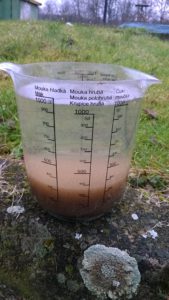
This is what a sludge sediment volume measurement might look like
Further maintenance depends on what you find out. Air problems usually do not occur, and its adjustment after some initial adjustment is rather rare. You can read how to set the air in another article.
If the sludge is not brown, it could be a problem with the air adjustment, or some other more serious problem. We also write about those elsewhere.
If the return sludge is not pumped, the pump must be put into operation, this is absolutely crucial for the treatment plant to function. If the return sludge is pumped with a mammoth, it is usually enough to add air all the way and the pipe will pass. If this does not help, it is necessary to disassemble and release the pipe, for example with a wire.
Floating Sludge Layer - Something is wrong with the air setting when it is on activation. It also usually means that there is too much activated sludge in the treatment plant. A thin layer of sludge on the settler is quite common, especially if the treatment plant does not have a drawdown of floating solids from the settler tank. Use a fan to transfer this layer back into the activation tank. The formation of a thick layer can then indicate low return sludge pumping performance or intensive denitrification in the settling tank. Sometimes the stilling cylinder (the tube in the middle of the settling tank) gets clogged. Some treatment plants have its aeration, which prevents this, in any case it is advisable to make this cylinder passable. It tends to be narrow, so spraying the "blanket" with water from a hose is usually the only solution.
Cloudy drain, or even an unusually colored (black) indicates either too high or too low concentration of sludge, or its disintegration. In any case, this is some sort of biological purification disorder.
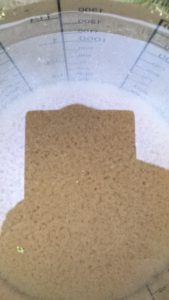
This is what a good settling sludge looks like with a clean supernatant (set-off water)
The rakes are caught on combs or a comb basket. It is ideal to be disciplined and not to throw anything in the trash that does not completely disintegrate in water within tens of seconds. So apart from faeces, toilet paper, water from the washing machine, dishwasher, or washing dishes, practically nothing should go into the waste. Definitely not pads, tampons, earplugs, non-woven fabrics (wet wipes), leftover food, oil... Read here What belongs in the waste and what doesn't. Think about the fact that you are adding work to yourself, and for everything you throw in the toilet, there is a risk that you will take it out of the treatment plant again, only much more dirty. After all, this also applies to those who are connected to the city sewer, only that someone else has to pull it for you.
Sludge concentration - if the sludge is low, you can bring in new or wait for it to build up. If there is a lot of sludge, it needs to be exported or drained and disposed of.
If you like to play and want to keep everything under control, you can measure temperature, or oxygen concentration and pH if you are equipped to do so. Of course, you can also get a tester for ammonia, or nitrates, or phosphorus if you precipitate it, and record and track these numbers.
It is advisable to write that:
in the operating record- the inspection took place (and when)
- Sludge volume after 30 minutes of sedimentation
- any other actions performed
- changes in settings (for example fan switch-on times)
- and possibly other optional activities:
- water temperature in WWTP
- state of the water meter in the household
- concentration of ammonia, nitrates, phosphorus
- consumption of chemicals
- whatever you can think of
- take the hose and clean the treatment plant
- if you have an aeration system drain, drain the water
Example of operational record:
| date | time | temperature | V30 | water meter | notes |
| °C | ml/l | m3 | |||
| 6/11 | 16:00 | 15 | 200 | 141 | |
| 15/11 | 15:40 | 11.6 | 100 | 144.8 | drain cloudy, smelly |
| 20/11 | 16:30 | 13.4 | 370 | 145,1 | inoculated with sludge from WWTP 2×25 l thickened sludge |
| 27/11 | 13:45 | 14.5 | 350 | 147.7 | drain clear |
| 3/12 | 13:00 | 9.5 | 350 | 148.7 | denitrification foam, permanent aeration on |
| 11/12 | 15:00 | 10.7 | 350 | 151 | cleaned blower filter |
| 18/12 | 17:00 | 13 | 400 | 153 | drain clear |
| 26/12 | 09:00 | not measured | unmeasured | 156,4 | drain clear |
| 31/12 | 11:15 | 10,1 | 440 | 158,8 | drain clear |
| 8/1 | 14:45 | 7,15 | 450 | 160.8 | clogged return sludge, cleaned |
| 15/1 | 16:30 | 7.44 | 470 | 162.6 | drain clear |
You can create your own traffic record, but you can find a downloadable template here .
Irregular activities
Irregularly can do anything. This is usually to fix a defect found during a regular weekly check.
PWhen the amount of sludge in the treatment plant increases, it is necessary to de-sludge. Up to 15 liters of excess sludge is produced per person per day. It then needs to be removed from the treatment plant. The best (but not necessarily the cheapest) is to have the sludge taken to another treatment plant by a specialized company. Another option is on-site composting, but be aware that there may be human parasites in the sludge, so be careful, for example with vegetable application (preferably not at all).
After several years of operation, it is advisable to empty the treatment plant and check the condition of the structure and aeration elements. A sediment of sand may also form which needs to be removed.
The lifespan of aeration elements is about 10 years. After this time it is advisable to replace them.
Also take care of the blower. According to the manufacturer's data, it is necessary to occasionally clean/replace the filter, possibly the oil, or the membrane. It depends on the specific type.
In the case of phosphorus precipitation, a peristaltic (hose) pump is often used, with which it is necessary to replace the tubing at prescribed intervals.
If the treatment plant has a settling and equalization zone before the biological stage, this too needs to be regularly checked and removed.
If there is a sump of purified water connected behind the treatment plant, it is advisable to drain and clean it roughly once a year.