


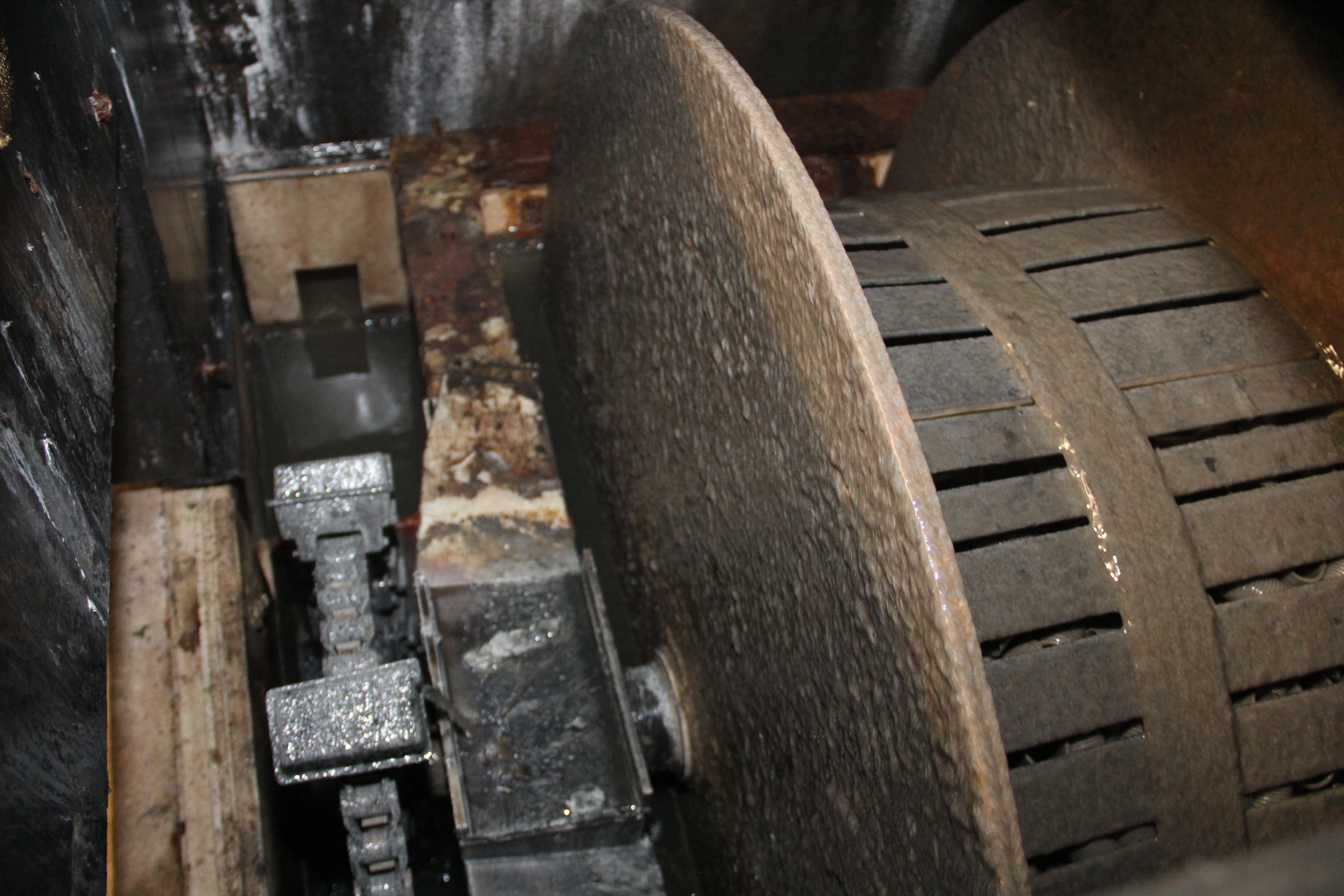
What a well-functioning biodisc treatment plant looks like
A typical biodisc treatment plant will be equipped with some kind of first stage, most likely in the form of a septic tank or slotted tank. In any case, this degree needs to fulfill its purpose. So that the water flows out of it in a qualitatively better condition than it flows into it. In particular, it should not be cloudy, rotten, and the first anaerobic stage should not be covered with a massive layer of rotting sludge (but the formation of a "blanket" is common. The point is that it does not flow to the biodisc.).
The proper function of the biodisc is characterized by the fact that it is covered with a layer of biofilm, which gradually changes color in the direction of the flowing water. Usually from dark brown to black, to lighter shades of brown, to brick. This is due to the fact that as the water quality changes (it is purified), so does the structure of the microorganisms represented in the biofilm. The biofilm layer should be continuous and even. If large areas without biofilm are visible, this is a problem that can be caused by, for example, disinfectants. If the biofilm grows unevenly, it is possible that the biodisc also rotates unevenly and some parts of it are submerged longer than others. Stopping the biodisk is inadmissible, on the one hand, this exposes part of the biofilm to dryness and part of the environment without oxygen, and then there is also a risk of uneven growth of the biofilm, which can even result in mechanical damage to the treatment plant (the biofilm can have a relatively high weight, especially if it is wet).
If the biofilm is completely black, it is probably insufficiently oxygenated, or the treatment plant is heavily overloaded. A gray color and possible slime formation is also not desirable, the causes can be similar to black color. White (to yellow) are not common on the biodisc itself, but coatings of this color can occur in other parts of the treatment plant. This is sulphide sulfur, which is produced by the oxidation of hydrogen sulphide, which is released into the air from wastewater. This is a common phenomenon, which indicates that the oxidation in this type of treatment plant is not as perfect (similarly, there are roots on it) as it is in an activation treatment plant.
Problems
The dying biopic
When there are large areas on the biodisc that are not covered by biofilm, this is a serious technological problem. The cause can be, for example, the supply of toxic substances in the wastewater, typically disinfection or cleaning agents. Another cause could be too high a load on the treatment plant, which would be manifested by cloudy inflow and outflow. Furthermore, this condition can also be caused by a low load - if the inflowing water is already very clean, there may not be enough nutrients available for the formation of a biofilm. The cause of problems can also be mechanical influences, such as too high rotation speed, uneven rotation, or friction against the sand in the trough under the biodisc, or the biofilm rubbing against an inappropriately designed or degraded structure of the biodisc. The biofilm must breathe, so it is necessary that it has an air supply. When the ventilation holes are closed, the biofilm may also die. This would probably also be manifested by the formation of a rather black biofilm and, in places where air can enter the treatment plant, by a white coating of sulphidic sulphur. Also, the smell would be an indicator of lack of oxygen.
Uneven growth of biofilm
Uneven increase is most often caused by uneven rotation, or even turning off the device. The effect on water quality may not be significant, but uneven stress on the equipment occurs and its lifespan is reduced.
Treatment overload
Because biofilm treatment plants are more suitable for diluted water, they may be overloaded when they are installed in a family house or boarding house. This manifests itself in various ways, such as impaired drainage, dying biofilm, odor, etc. In most cases, this is a defect already in the design phase, and it would be best to switch to another type of treatment plant. However, if the hydraulics allow it (especially the water pumping system for the reactor itself), it is possible to recycle part of the cleaned water at the entrance to the treatment plant, which will dilute the inflow and equalize the load.
The solution could also be precipitation of organic substances in the inflow to the treatment plant using iron or aluminum salts and subsequent removal of the precipitate in the sedimentation area. However, it is necessary to calculate that the doses will be relatively high and the need to balance the sludge will increase.
Curdy Drain
Curdy drain can be caused by any of the problems listed above. The cause may be an already cloudy inflow from pre-cleaning. It is advisable to check the amount of sludge in the system, especially in the sedimentation part at the inlet to the treatment plant and then the amount of sludge in the settling part behind the biofilm reactor (if it is not drained to the inlet part - then check the functionality of this sludge removal). It is advisable to remove the sludge regularly.
Technological parameters
Some problems can also be caused by an inappropriate type, size or design of the treatment plant. Below is a list of basic recommended parameters:
To treat wastewater from one equivalent population (EO), the loading area needs to be at least 5 m2 if ammonia is not to be removed. However, when the wastewater treatment plant is to clean, ammonia should also be removed, then 10 m2 per EO is recommended, but a little more is better, because the given number is the lower limit.
Settling tanks in biofilm reactors are not as heavily loaded with suspended solids as in the case of activation treatment plants, and do not need to be cleaned continuously. However, it is advisable to pump out the sludge at least once a day, the optimal condition is to start pumping the sludge for a short time every hour.
The area of the settling tank depends on the hydraulic load (or rather vice versa) and should be 1 m2/m3/h (up to 2.4 m3/m2/h can be handled in the short term). Here it can be considered that one EO will produce approx. 100 l of wastewater per day, but this production will be very uneven. So 0.04 m2/EO.
can be consideredAs far as pre-cleaning with a slot tank or septic tank is concerned, the area of the sedimentation area is also important here. It should be at least similar to the spacer, but it is better if it is at least half as high, i.e. 0.06 m2/EO. Volume is also important here. A volume of sedimentation (digestion) space of 0.15 m3/EO is recommended. However, temperature also plays a role here, and if it is not possible to ensure temperatures permanently above 12 °C, then it is better to choose a higher volume, preferably double. The larger the volume, the longer it can last without balancing.